This was a Japanese traditional story. One day, a young fisher named Urashima Taro saves a small turtle from boys who are abusing it. The next day, a turtle comes to thank him by taking him down to the Dragon Palace at the bottom of the sea, where he spends time as if in a dream. But when he returns home, many more years have passed than he had realized. Overcome with sadness, he lifts the lid of a treasure box he was given when he left the Dragon Palace, despite being warned that he should never open it…
Once upon a time there lived a young fisherman named Urashima Taro. One day, Taro came upon some children who were tormenting a sea turtle on the beach. Feeling pity for the turtle, Taro told the children to let it go, but they would not stop. Taro finally saved the turtle and let it return to the sea.
Several days later, the turtle appeared before Taro once again and called to him. “Thank you for rescuing me the other day. You saved my life.” The turtle then extended an invitation. “In return, please allow me to show you Ryugu-jo, the palace of the Dragon King. Come, ride on my back.” Taro thought he would indeed like to see Ryugu-jo, so he seated himself on the turtle’s back. He and the turtle dove to the bottom of the ocean.
In a glance, Taro and the turtle had arrived at the magnificent gates of Ryugu-jo. At the palace, the princess Otohime gave Taro a warm welcome. Taro watched the sea bream and flounders dance, took part in many feasts, and had a wonderful time. After a few days had passed, though, Taro grew homesick for his village and his mother. He told Otohime that he wished to go back home. The princess was greatly distressed at his words, but gave him a gift—a special box called a tamatebako—with strict instructions to never open it.
Taro rode a turtle back to shore. When he arrived, however, the beach seemed completely different. Taro’s home was gone—and so was his mother. Everyone that Taro knew was gone. When he asked the people nearby if they knew an Urashima Taro, they replied that they had indeed heard stories about someone by that name, who long, long ago sank beneath the ocean waves and disappeared. It was then that Taro learned that three hundred years had passed since he had gone to Ryugu-jo. Thinking that all might return to the way it had been if he opened the tamatebako, Taro lifted the lid despite what the princess had told him. When he did so, however, a puff of white smoke came out of the box. The white smoke engulfed Taro and left him an old man, with white hair and beard.
The Sightseeing Limited Express Train “Ibusuki no Tamatebako”:
Based on Urashima Taro’s Legendary Tamatebako
The Kyushu Railway Company (JR Kyushu) operates the “Ibusuki no Tamatebako,” a limited express sightseeing train that takes its name from the legend of Urashima Taro of Kyushu’s Satsuma Peninsula. The train’s bold color scheme—the cars are painted half-white and half-black—and the white mist that sees you off when the doors open and you arrive at the station make it just like a tamatebako on rails.
ual Indigenous place names have been added to two iconic sites in Byron Bay following calls from the community to acknowledge their cultural significance.
The NSW Geographical Names Board approved a submission to officially dual-name Cape Byron as Walgun and Julian Rocks as Nguthungulli.
Walgun, meaning “shoulder” in Bundjalung language, holds significance to the Arakwal and other Bundjalung people as an important ceremonial and gathering site.
Nguthungulli, said to be “the Father of the World”, is an important sacred Aboriginal site associated with several dreaming stories of the Arakwal and other Bundjalung people. Continue reading
The board and Byron Shire Council will also formally name a reserve in the suburb of Bangalow as Piccabeen Park.
Piccabeen is Bundjalung word used to describe the Bangalow Palms found in the area, including the baskets made from its palm frond.
The NSW government has supported a dual naming policy for cultural sites since 2001.
Minister for Customer Service and Digital Government Jihad Dib said the government remained committed to the preservation and promotion of Aboriginal languages and acknowledging Aboriginal culture through place naming.“Place naming gives communities the opportunity to unlock past stories, preserve traditions, reawaken language and provide a sense of belonging and identity,” Dib said.
“All Australians share a relationship to the land and the names we give to places convey their significance, sense of history and identity.
“Dual-naming acknowledges the significance of Aboriginal culture and represents a meaningful step towards the process of unity in NSW.”
Minister for Aboriginal Affairs and Treaty David Harris said acknowledging the history and connection through names brought Story and Language to life for all Australians.
“The Arakwal and other Bundjalung people have had unbroken connections to these places through Story, kinship and Language since the first sunrise,” he said.
One of the biggest debates between generations right now is whether millennial fashion is classic or cringey — so I took the question to New York Fashion Week.
A model walks the runway at PatBo’s New York Fashion Week show on September 9, 2023.
Unfortunately, for those born between 1981 and 1996, members of Gen Z have decided that skinny jeans are outdated, side-part hairstyles look odd, and “going-out tops” are things of the past — much to the disagreement of many millennials.
So when I attended New York Fashion Week on Saturday, I figured it was the perfect time to ask fashionable people from both generations about their thoughts.
Their answers were mixed, to say the least.Advertisementhttps://37066e2946ab76466ae83b1319bea14b.safeframe.googlesyndication.com/safeframe/1-0-40/html/container.html
Actor and style blogger Temi Otedola knew immediately which millennial fashion trend she’d get rid of.
Temi Otedola attends the PatBo runway show during New York Fashion Week on September 9, 2023.
“Skinny jeans,” she replied instantly while shaking her head.
TV personality Blake Newby said millennials need to be careful about what they’re wearing under their outfits.
Blake Newby attends the PatBo runway show during New York Fashion Week on September 9, 2023.
“Improper undergarments are something that drives me nuts. We struggle with it,” she told Insider. “We must prioritize wearing the right undergarments for our looks.”
But as a millennial herself, there’s also one trend Newby stands by: wedges.
“This is going to be very controversial, but I think we should defend wedges — the right wedge done the right way,” she said.
And Newby might be onto something. One stylist who previously spoke with Insider about this summer’s footwear styles said wedges with unique details like straps and open backs could be “the hottest shoe trend for 2023.” Advertisementhttps://37066e2946ab76466ae83b1319bea14b.safeframe.googlesyndication.com/safeframe/1-0-40/html/container.html
Fashion and beauty creator Hana Martin said she’s a millennial-fashion defender.
Hana Martin attends the PatBo runway show during New York Fashion Week on September 9, 2023.
“I’m a Gen Z, but I really love millennial style,” Martin said. “I actually think I’m in with it.”
One trend she loves in particular is the the old-money aesthetic, which makes use of neutral-colored garments, classic prints (think houndstooth and stripes), and timeless fabrics like linen to evoke the image of being wealthy and having a chic lifestyle.
“The classy, elegant style is really in at the moment for Gen Z, and millennials are the OG of that. I love that trend,” she said.
As Martin noted, Gen Z influencers like Sofia Richie Grainge have catapulted the style in recent months. Millennials, however, were the first generation to look at icons like Jackie Kennedy Onassis and Princess Diana as old-school inspiration.
Influencer Amy Lefévre said there are two millennial styles that need to go.
Amy Lefévre attends the PatBo runway show during New York Fashion Week on September 9, 2023.
“I’m really tired of the overly cropped tops, even cropped T-shirts,” she said. “And skinny jeans need to go. They never should have existed in the first place.”Advertisement
Dawn, a drag queen from Brooklyn, also had opinions on millennial pants.
Dawn attends the Cucculelli Shaheen show during New York Fashion Week on September 9, 2023.
“The worst is the high, high-waisted jeans. A nice mid-rise is really OK,” she said with a laugh.
Still, there is one denim style that Dawn says millennials have mastered.
“Are overalls millennial? I think so. I love an overall,” she said.Advertisement
Model Carmen Lee said she feels millennials are often more fashionable than Gen Z.
Carmen Solomons attends the Cucculelli Shaheen show during New York Fashion Week on September 9, 2023.
“The thing about millennials is that everything we have come up with is still in fashion to this day,” she said. “Gen Z is trying to implement all our fashion trends.”
Specifically, Gen Z has been reviving millennial-created trends that the older generation hates. So far, they’ve brought back ballet flats, low-rise pants, and the Fendi Baguette — all former style staples of millennials.
“There hasn’t been anything I’ve learned from Gen Z that I’m like, ‘Oh, that’s timeless.’ No honey,” she added.Advertisementhttps://37066e2946ab76466ae83b1319bea14b.safeframe.googlesyndication.com/safeframe/1-0-40/html/container.html
Stylist Odera Nkem-Mmekam gives millennials some credit but thinks they need to reconsider at least two trends.
Odera Nkem-Mmekam attends the Cucculelli Shaheen show during New York Fashion Week on September 9, 2023.
“Do you remember the color-blocking thing that happened? I was just thinking about that today. It was awful — like really, really bad,” she said. “But millennials did indie sleaze, and that was cute, honestly.”
Indie sleaze is an aesthetic that mixes grunge pieces with more hipster-esque ones. It was most popular in the mid-2000s and early 2010s.Advertisementhttps://37066e2946ab76466ae83b1319bea14b.safeframe.googlesyndication.com/safeframe/1-0-40/html/container.html
Model Alioune Fall says many millennials make the mistake of trying to wear Gen Z trends rather than what they like.
Alioune Fall attends the Cucculelli Shaheen show during New York Fashion Week on September 9, 2023.
Noting that it’s an “unpopular opinion,” Fall said he’s not a fan of millennials leaning into the “skateboarding style” and Y2K trends that Gen Z love. Instead, he wishes millennials focused on more chic styles.
“I think it’s time to come back to classic looks, suits, tailoring, and wearing what fits your body — not just trends,” he said.
CO2 does not cause significant climate change and the Green New Deal will have no significant effect on climate.
Water vapor is a transparent gas that, molecule for molecule, is at least as effective at absorbing/emitting earth-temperature infrared radiation (IR) as carbon dioxide. From January 1988 through December 2021, NASA/RSS accurately measured and reported monthly the global average water vapor as Total Precipitable Water (TPW). In January 2022, they stopped reporting new global average TPW measurements, a year later deleted the website completely and shortly after that replaced it. At ground level during the period of reporting, average global water vapor molecules increased about 7 times faster than CO2 molecules.
Further analysis shows that the determination by molecule count, that increased CO2 influence on the climate has been only one-seventh as much as the increased water vapor influence, is still high. Radiation from water vapor as low as about 2 kilometers can make it all the way to space and carries away any residual contribution to warming from increased CO2 at low altitude. Radiation to space from CO2 and other IR-active gases is from the tropopause (about 6 to 18 km) and above and actually counters warming.
The end result is that CO2 does not cause significant climate change and the Green New Deal will have no significant effect on climate.
This article has been upload in theepochtimes.com/australia/
Two Australian researchers scrunitised the claim that just 5 percent of rape allegations are false
A sculpture of ‘Lady Justice” is seen above the entrance of Amtsgericht Charlottenburg (Charlottenburg District Court) in the neighbourhood of Charlottenburg in Berlin on Sept. 5, 2023. (Odd Andersen/AFP via Getty Images)
Commentary
Remember how the Brittany Higgins case blew up when a juror brought into the jury room an academic paper discussing the frequency of false allegations of sexual assault?
That broke the rules prohibiting jury members from accessing outside material relevant to the case.
Yet the significance of this extraordinary event, which led to the mistrial of one of Australia’s most sensational rape cases, has passed largely unnoticed.
The myth that women hardly ever lie is a central plank of the feminist myth about sexual assault which now underpins our justice system. That makes it absolutely vital for the movement to maintain the fallacy that false allegations are statistically extremely rare.
Boy, have they done a great job in promoting that mistruth.
The mantra that false allegations hardly ever happen lurks as a dangerous subtext in sexual assault cases hitting the courts in Australia.
Bruce Lehrmann’s lawyers are preparing for next month’s defamation battle against Network 10, Lisa Wilkinson, and the ABC over their coverage of last year’s criminal case.
But The Guardian newspaper is determined, running a headline claiming Network 10 lawyers will “seek to use evidence of rarity of false rape complaints.”
Bruce Lehrmann leaves the ACT Magistrates Court in Canberra, Australia, on Oct. 26, 2022. (Martin Ollman/Getty Images)
But what about that evidence?
Well, it’s not hard to guess what Network 10 experts would trot out. Five percent of rape allegations are found to be false, they claimed. That’s the party line and you’ll find it promoted everywhere.“Guys, you can stop worrying about false rape allegations. They’re extremely rare,”saidthe ABC’s Hack program, pitched at young people.The Sydney Morning Heraldrecentlypronounced that we do not have a major problem with men being falsely accused of sexual assault, claiming “statistics show false complaints of sexual assault are incredibly rare—a 2016 meta-analysis of seven studies of rape allegations in four Western countries put confirmed false police reports at 5 percent.”They’re all singing from the same songbook, but that’s just been shot full of holes.
Let’s Test That 5 Percent Claim
Finally, that famous meta-analysis has been subjected to proper scrutiny—and the data actually reveals false allegations are far less rare than is commonly claimed.
This is all courtesy of two Australian researchers, Tom Nankivell and John Papadimitriou, who have expertise in statistical analysis and public policy, and more than three decades of experience each as researchers and policy analysts with various government agencies.They conducted a review (pdf), titled “True or false, or somewhere between?” in which they analysed the methods and data reported in often-cited statistical surveys of the prevalence of false allegations, undertaken in various countries.
This research was recently highlighted by Oxford criminology researcher, Ros Burnett, who described the Nankivell/Papadimitriou review as “an important and overdue study,” commending the authors for bringing “an empirical approach and unrhetorical tone to the discussion.”Ms. Burnett’s discussion of the review, published last month in The Justice Gap, shows that the Ferguson and Malouff meta-analysis on the statistical studies that came up with the much-promoted 5 percent false allegation rate, misused policing definitions and categories to skew their results.
In effect, the surveys cherry-picked the lowest possible rate, selectively ignoring whole categories of cases likely to include false allegations.
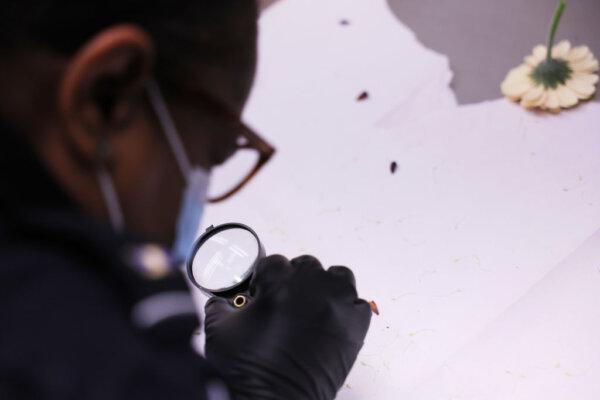
A U.S. Customs and Border Protection specialist inspects flowers for insects with a magnifying glass at JFK Airport in New York City, on Feb. 7, 2023. (Michael M. Santiago/Getty Images)
Get this … in counting up false allegations, the studies that Mr. Ferguson and Mr. Malouff re-analysed only included cases where the complainant admitted the allegation was false, or where police found strong evidential grounds to assume she (or he) had made it up or had been mistaken.That meant excluding all cases where there was insufficient evidence to prosecute, where the complainant withdrew the allegation, or where the accused was tried and acquitted.
None of these cases were included under false allegations!
In addition, at least one of the studies included basic mathematical errors while others relied on very limited data.
With this highly dubious culling of the data, it is no wonder that they come up with such a low rate of false allegations.
Mr. Nankivell and Mr. Papadimitriou laboriously re-examined the original data to include estimates of possible false allegations in these excluded categories.
They concluded that “even with reasonably modest assumptions about the actual level of false allegations in other categories, the prevalence rate for the studies sample would easily exceed 10 percent and could approach 15 percent.”Note this is the conclusion from two very conservative, quantitative researchers.
The Narrative Sidelines True Victims
Given what we now know, what’s the bet the real rate is actually far higher?According to a recent YouGov survey, 19 percent of Australians know someone personally who was a victim of a false accusation of sexual abuse or rape.
Yet the Nankivell/Papadimitriou report is vital information, so necessary for putting the record straight about this critical statistic which is being used to shut down debate on false allegations and undermine the chances of a fair hearing for accused men.In her article examining this research, Ros Burnett discusses her own work for over a decade as a criminologist looking at wrongful allegations—she’s the editor of an excellent book, “Wrongful Accusations of Sexual and Child Abuse.”
Mr. Burnett describes the hundreds of cases she has encountered where individuals have been found to be falsely accused and her frustration when such cases are dismissed as “extremely” or “vanishingly” rare. She has been personally accused of “being an apologist for rapists.”
That’s the climate we live in, where misinformation is cooked up to promote the women-don’t-lie narrative and denigrate anyone with the courage to tell the truth about what’s really going on.
Mr. Nankivell and Mr. Papadimitriou rightly make the point that “there is no credible evidence that women routinely fabricate sexual assault claims” and that “the majority of sexual assault reports are true.”
But what also muddies the waters is the massive expansion of the type of behaviour now classified as sexual assault.
There’s a steady stream of cases now finding their way into court which involve young couples, where a girl may suddenly decide that she hadn’t given consent on one occasion after having intercourse when she was half asleep, or pretty drunk, even though they might have done this dozens of times before.
It makes no sense.Views expressed in this article are opinions of the author and do not necessarily reflect the views of The Epoch Times.Bettina ArndtAuthor
Mother Teresa (1910–1997) was a Roman Catholic nun who devoted her life to serving the poor and destitute around the world. She spent many years in Calcutta, India where she founded the Missionaries of Charity, a religious congregation devoted to helping those in great need. In 1979, Mother Teresa was awarded the Nobel Peace Prize and became a symbol of charitable, selfless work. In 2016, Mother Teresa was canonised by the Roman Catholic Church as Saint Teresa.
“It is not how much we do, but how much love we put in the doing. It is not how much we give, but how much love we put in the giving.”
Mother Teresa was born in 1910 in Skopje, the capital of the Republic of Macedonia. Little is known about her early life, but at a young age, she felt a calling to be a nun and serve through helping the poor. At the age of 18, she was given permission to join a group of nuns in Ireland. After a few months of training, with the Sisters of Loreto, she was then given permission to travel to India. She took her formal religious vows in 1931 and chose to be named after St Therese of Lisieux – the patron saint of missionaries.
On her arrival in India, she began by working as a teacher; however, the widespread poverty of Calcutta made a deep impression on her, and this led to her starting a new order called “The Missionaries of Charity”. The primary objective of this mission was to look after people, who nobody else was prepared to look after. Mother Teresa felt that serving others was a fundamental principle of the teachings of Jesus Christ. She often mentioned the saying of Jesus,
“Whatever you do to the least of my brethren, you do it to me.”
As Mother Teresa said herself:
“Love cannot remain by itself – it has no meaning. Love has to be put into action, and that action is service .” – Mother Teresa
She experienced two particularly traumatic periods in Calcutta. The first was the Bengal famine of 1943 and the second was the Hindu/Muslim violence in 1946, before the partition of India. In 1948, she left the convent to live full-time among the poorest of Calcutta. She chose to wear a white Indian sari, with a blue border, out of respect for the traditional Indian dress. For many years, Mother Teresa and a small band of fellow nuns survived on minimal income and food, often having to beg for funds. But, slowly her efforts with the poorest were noted and appreciated by the local community and Indian politicians.
In 1952, she opened her first home for the dying, which allowed people to die with dignity. Mother Teresa often spent time with those who were dying. Some have criticised the lack of proper medical attention, and their refusal to give painkillers. Others say that it afforded many neglected people the opportunity to die knowing that someone cared.
Her work spread around the world. By 2013, there were 700 missions operating in over 130 countries. The scope of their work also expanded to include orphanages and hospices for those with terminal illnesses.
“Not all of us can do great things. But we can do small things with great love.”
- Mother Teresa
Mother Teresa never sought to convert those of another faith. Those in her hospices were given the religious rites appropriate to their faith. However, she had a very firm Catholic faith and took a strict line on abortion, the death penalty and divorce – even if her position was unpopular. Her whole life was influenced by her faith and religion, even though at times she confessed she didn’t feel the presence of God.
The Missionaries of Charity now has branches throughout the world including branches in the developed world where they work with the homeless and people affected by AIDS. In 1965, the organisation became an International Religious Family by a decree of Pope Paul VI.
In the 1960s, the life of Mother Teresa was brought to a wider public attention by Malcolm Muggeridge who wrote a book and produced a documentary called “Something Beautiful for God”.
In 1979, she was awarded the Nobel Peace Prize “for work undertaken in the struggle to overcome poverty and distress, which also constitutes a threat to peace.” She didn’t attend the ceremonial banquet but asked that the $192,000 fund be given to the poor.
In later years, she was more active in western developed countries. She commented that though the West was materially prosperous, there was often a spiritual poverty.
“The hunger for love is much more difficult to remove than the hunger for bread.”
- Mother Teresa
When she was asked how to promote world peace, she replied,”Go home and love your family”.
Over the last two decades of her life, Mother Teresa suffered various health problems, but nothing could dissuade her from fulfilling her mission of serving the poor and needy. Until her very last illness she was active in travelling around the world to the different branches of The Missionaries of Charity. During her last few years, she met Princess Diana in the Bronx, New York. The two died within a week of each other.
Following Mother Teresa’s death, the Vatican began the process of beatification, which is the second step on the way to canonization and sainthood. Mother Teresa was formally beatified in October 2003 by Pope John Paul II. In September 2015, Pope Francis declared:“Mother Teresa, in all aspects of her life, was a generous dispenser of divine mercy, making herself available for everyone through her welcome and defense of human life, those unborn and those abandoned and discarded,”“She bowed down before those who were spent, left to die on the side of the road, seeing in them their God-given dignity. She made her voice heard before the powers of this world, so that they might recognize their guilt for the crime of poverty they created.”
Mother Teresa was a living saint who offered a great example and inspiration to the world.
Awards given to Mother Teresa
The first Pope John XXIII Peace Prize. (1971)
Kennedy Prize (1971)
The Nehru Prize –“for the promotion of international peace and understanding”(1972)
Albert Schweitzer International Prize (1975),
The Nobel Peace Prize (1979)
States Presidential Medal of Freedom (1985)
Congressional Gold Medal (1994)
U Thant Peace Award 1994
Honorary citizenship of the United States (November 16, 1996),
The building that houses both the Masdar and International Renewable Energy Agency headquarters will have stores and restaurants in addition to office space, powered by 1,000sqm of photovoltaic panels. While no residential buildings beyond dormitories have been built, they are in the works. “There are various residential plots around the city, and over the coming years they will be tendered out to global architects,”Zaafrani explained. The city’s economic free zone “ with zero taxes, import tariffs or restrictions on foreign hires “ is set up to specifically attract clean energy and tech companies, clustering them together in incubator office buildings. “The number one target is people who work in Abu Dhabi and around the UAE,” Zaafrani said. “We are trying to make sure as we build up the city, there will be demand for both commercial and residential spaces. “Currently, a four-bedroom villa in central Abu Dhabi rents for around 200,000 dirhams a year, while a two-bedroom flat in Reem Island rents for around 100,000 dirhams. Over the next two years, 45,000 new flats and houses will come available.The National: English-language daily covering news, features, arts and culture across the Emirates Related article: The futurist “ Masdar City
Former Expo Site, Shanghai Rather than building an entirely new city (although China is doing that too, by the dozens), Shanghai is taking the area that housed the 2010 Shanghai World Expo on the Pudong and Puxi sides of the Huangpu River and turning it into a city-within-a-city. While the Expo originally displaced 18,000 families, it was themed around urban sustainability and efficiency, and the city invested heavily in the sites infrastructure so it could be redeveloped after the fair was over and the pavilions dismantled. Parks, green space, water features and cultural institutions such as the large red China Pavilion, now a museum – were left to be incorporated into mixed-use projects containing apartments, hotels, offices, shopping malls and restaurants. By 2016, two hotels and some office and retail space will be completed, and in May 2013 the 50,000sqm Green Valley project broke ground. Near the China Pavilion, the project will form the central axis of the overall site with sustainable commercial space, restaurants and offices, all linked by open courtyards, gardens and other green spaces.The Shanghai housing market is rising quickly, and recently the government reacted to fears of a bubble by directing banks to stop giving mortgages to people buying their third home. The median house price in the city centre is currently 42,500 renminbi per square metre, and a new-build, two-bed flat in Pudong can start at 8 million renminbi. A one-bedroom city centre flat rents for about 6,000 renminbi per month, and a three-bed in the centre rents for 14,500 renminbi.
Victoria, British This Canadian city across the Puget Sound from Seattle, Washington, has created an urban experiment within its borders with the Dockside Green development on the city’s harbourfront. The three neighbourhood master plan is based on the tenets of New Urbanism, with its focus on density, community and sustainability. Dockside Wharf has been completed, and Dockside Commons and Dockside Village are not yet under construction. Streets are walkable, housing is diverse and energy efficient, and residential and commercial spaces are densely packed but close to nature trails and ponds. The three developments and 26 buildings, designed by Perkins + Will Architects, are LEED platinum certified and built on a former industrial site. Strong eco-credentials include the fact that the buildings use 55% less than water than traditional condos and were constructed using low VOC paint and eco-friendly materials such as bamboo flooring and carpets made from recycled material.Western Morning News: News and events from around Devon and the West Country Song Do,Korea Photo by Robert Koehler/getty Song Do Photo by SJ Kim/getty Incheon Bridge Photo by SJ Kim Masdar City Photo by Karim Sahib/AFP/Getty Photo by Tony Burns/LPI/Getty Photo by Karim Sahib/AFP?Getty Photo by Feng Li/Getty Photo by 2013 Photo by 2013 Photo by 2013
Shih Ming-Teh (Nory) Leader of people opposition in Taiwan. Look shy, but fierce in action Shy looks but powerful in act
The Dark Years In prison Shih met two other detainees whom he recognised from his military training, and lost what little cheer he had left when they told him that the minimum sentence that such prisoners received was two years.’Two years!’ the thought seared his mind. For a young man experiencing the most delicious period of his life, it might as well have been two hundred.
When the other two inmates hatched a plan to escape to the nearby mountains where one of them had a relative,Shih was right there in the front row.But the map showing the way to rendezvous house fell into the hands of the guards.
Escape attempts breed wrath.Shih was sent with his fellow collaborators and 17 other prisoners to the Taiwan Garrison Command’s Security Centre-the army’s favourite torture house – in the heart of Taipei. Their heads shaved,the prisoners were shackled together at the ankles and squeezed into a small cell.Given the opportunity to bathe only twice a week,the odour that reeked from the cell became positively dreadful.
The new interrogators said little,preferring to deal out slugs and kicks. Shih was led to the interrogation room with his hands cuffed behind him.The same questions were put to him again.”What was the Taiwan Independence League all about? growled a scruffy looking questioner.
Outside Taiyuan was altogether another world. Taiwan’s economy was expanding eapidly,with the GDP showing annual increases of eight to ten per cent.The GNP per capita had bounded from US$50 in a once soporific,agrarian society to USS$ 2,500 in an economy that had become a redoubtable trading juggernaut.With much fanfare,the Republic of China gloated over its economic accomplishment at the expense of those less sophisticated political infidels across the Taiwan Straits.
But all was not sunshine and Shaoxing wine for Taiwan, still labouring under martial law. With intellectual and economic attainment, the middle class became more assertive. The benshengren had no special affiliation with China, and that ‘glorious return to the mainland’ had all but become a fatuous fantasy of a dislocated band of Kuomintang soldiers. To the Taiwanese,the island was home and no nationalistic exhortation was going to alter that fact. Meanwhile many of them were becoming restive at being shut out of the governing process.
Half a world away, embarrassed by its ally’s authoritian streak, the United States mounted pressure on Chiang Kai-shek to introduce political reforms. In order not to ruffle feathers in Washington — which Taiwan depended on for its defence weaponry


 Continue reading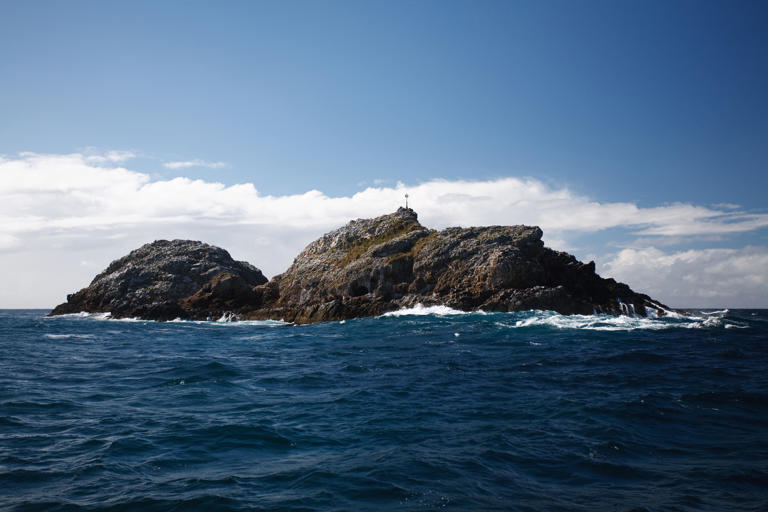




 Mother Teresa (1910–1997) was a Roman Catholic nun who devoted her life to serving the poor and destitute around the world. She spent many years in Calcutta, India where she founded the Missionaries of Charity, a religious congregation devoted to helping those in great need. In 1979, Mother Teresa was awarded the Nobel Peace Prize and became a symbol of charitable, selfless work. In 2016, Mother Teresa was canonised by the Roman Catholic Church as Saint Teresa.
 Mother Teresa was born in 1910 in Skopje, the capital of the Republic of Macedonia. Little is known about her early life, but at a young age, she felt a calling to be a nun and serve through helping the poor. At the age of 18, she was given permission to join a group of nuns in Ireland. After a few months of training, with the Sisters of Loreto, she was then given permission to travel to India. She took her formal religious vows in 1931 and chose to be named after
  She experienced two particularly traumatic periods in Calcutta. The first was the Bengal famine of 1943 and the second was the Hindu/Muslim violence in 1946, before the partition of India. In 1948, she left the convent to live full-time among the poorest of Calcutta. She chose to wear a white Indian sari, with a blue border, out of respect for the traditional Indian dress. For many years, Mother Teresa and a small band of fellow nuns survived on minimal income and food, often having to beg for funds. But, slowly her efforts with the poorest were noted and appreciated by the local community and Indian politicians.